
BCG and Anthropic leave five relevant questions open on KYC agents
November 16, 2026 · 9 minutes
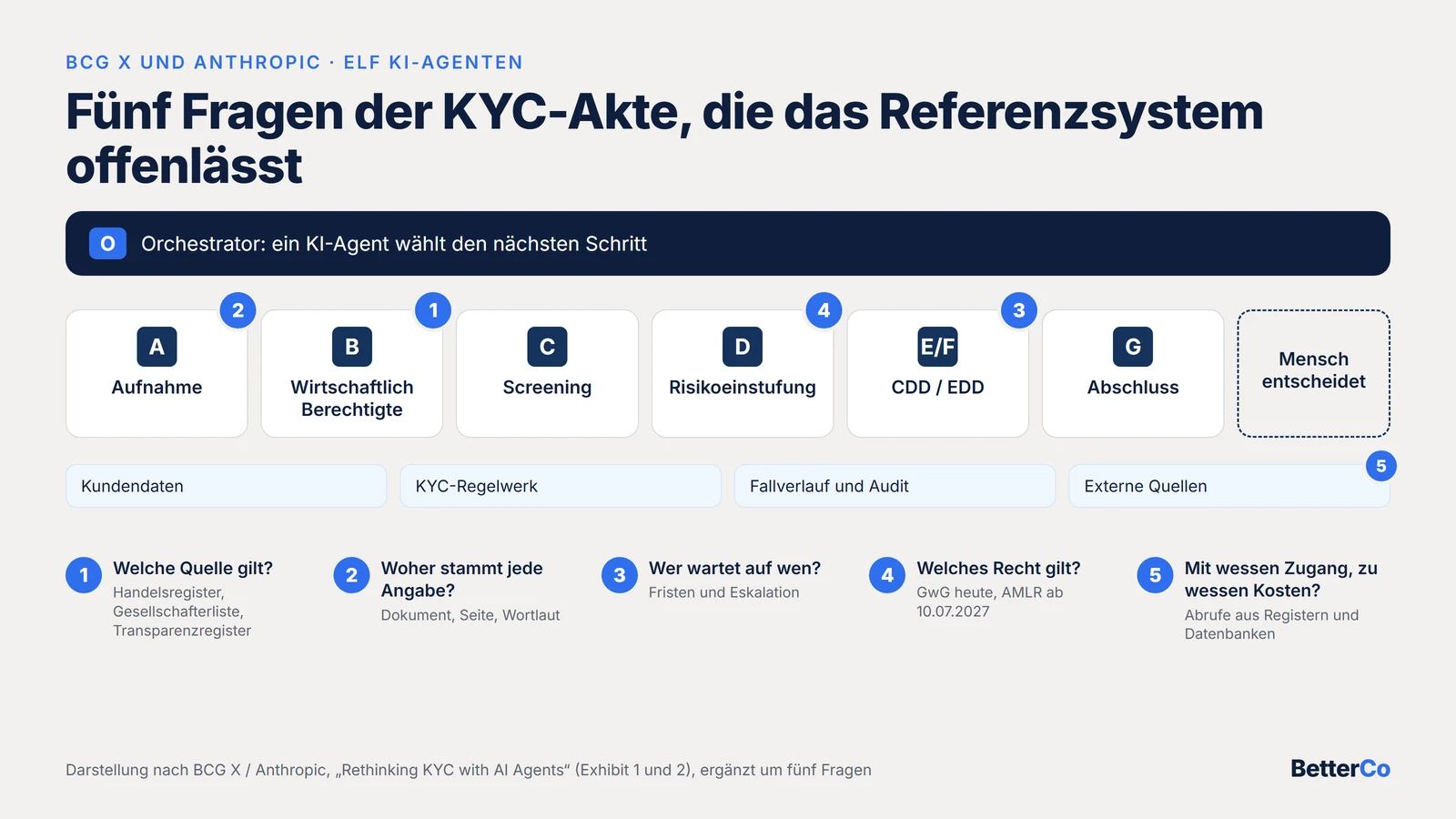
On November 4, 2026, BCG and Anthropic described how eleven AI agents jointly carry out the KYC check of a client (Rethinking KYC with AI Agents). German obliged entities can adopt the principles BCG derives from this, and three of them matter most for the KYC file. Fixed rules deliver repeatable results, a human approves consequential steps, and the evaluation of results is built before deployment. The paper does not address five questions that decide whether a supervisory authority can later trace the KYC file of a corporate client. They concern the ranking of conflicting sources, the origin of every piece of information, deadlines and escalation, the applicable law, and the cost of and access for data retrievals.
Key points
- BCG and Anthropic built a reference system with eleven agents on top of the KYC Screener.
- Fixed rules, human approvals and an evaluation before deployment carry over to German obliged entities.
- The paper does not address the ranking of sources, the origin of each piece of information, deadlines, the applicable law or the cost of data retrievals.
- Only confirmed real cases show whether an AI system identifies beneficial owners correctly.
BCG and Anthropic describe an onboarding system for large banks
The starting point is the KYC Screener from Anthropic's plugin library for financial services, with four agents and three skills. Our article on the KYC Screener describes what it does and what content German obliged entities add themselves. From it, BCG and Anthropic built a system with eleven agents, 17 skills and connections to internal and external data sources. An orchestrator, itself one of the eleven agents, assigns the case to seven agents for the core steps. They handle intake, beneficial owners, screening, risk rating, standard or enhanced due diligence, and case closure. Three more agents draft communication with the client, handle rejections and check every step before the analyst approves it.
Beneath the agents sit a KYC rulebook, a database for case history and audit, and an evaluation framework with more than 50 automated evaluators and synthetic data. According to BCG, a typical KYC file requires more than eight hours of manual work, and a large international bank spends one to two billion US dollars a year on risk and compliance. The paper describes a reference system and names no client deployments.
German obliged entities can adopt the principles
BCG names five principles. The business process comes first, the technology second. For each task, BCG chooses the right tool. Fixed rules deliver results that must be repeatable, generative AI reads and summarizes documents, and agents control processes across several steps and sources. Domain expertise and AI engineering work together from the start. Controls and human accountability are part of the architecture. The evaluation framework is built before the system.
For BCG and Anthropic, more agent autonomy is not a goal in itself (“the objective isn't to simply maximize agent autonomy”). An analyst approves consequential steps, such as communication with the client and the closure of a case. This way, the obliged entity also makes the decision it is responsible for. The paper has banks with their own analysts in mind. At a law firm or a brokerage, a single person often does the checking, and every approval must be designed so that this person does not hold up the case.
Whoever decides the next step should be able to explain the check later
In the paper, the orchestrator decides which agent works next based on the case and the results so far, instead of following a fixed sequence. It is one of the eleven agents running on Anthropic's agent platform. The paper mentions a database for case history and audit but does not describe how it records why the orchestrator chose a particular agent. A supervisory authority or internal audit may ask a year later why one case went through enhanced due diligence and another did not.
A fixed rule answers this question with its name and version, applied to the data of the case. With a frozen configuration, the case can be replayed and reaches the same result. An agent that controls the process needs a log of every decision, including model version and inputs. Even then, replaying remains an approximation, because a language model does not necessarily give the same answer to the same input. BCG itself recommends fixed rules for results that must be repeatable. In our view, the order of the check steps is one of them.
The KYC file of a corporate client raises five questions
The paper describes onboarding for banks with data from 20 to 30 internal and external sources. It does not address the following five questions.
Which source wins when the registers contradict each other?
For a GmbH, the commercial register, the shareholder list and the Transparency Register can differ from each other. Information from the Transparency Register alone is not sufficient (Section 11(5) sentence 3 GwG), and discrepancies must be reported (Section 23a(1) GwG). In our view, a traceable KYC file therefore follows a fixed ranking.
The shareholder list filed in the commercial register.
A shareholding chart drawn by the client.
The information in the Transparency Register. If a person resolves a conflict, their decision is recorded with their name and
reasons in the KYC file.
An example shows why the ranking matters. In the fictitious Muster GmbH, Ms. A holds 40 percent and a Holding GmbH holds 60 percent. Mr. B holds half of the Holding, and several family members share the other half in small stakes. The Transparency Register lists only Ms. A, and the client's chart shows the Holding without Mr. B. Under the ranking, the shareholder list prevails. Today, the Transparency Register entry is correct, because with half of the shares and no further rights, Mr. B usually does not control the Holding (Section 3(2) GwG). From July 10, 2027, Mr. B reaches 60 times 50 percent, or 30 percent (Art. 52(1) AMLR), and is therefore a beneficial owner. If the Transparency Register then differs, this must be reported (Art. 24(1) AMLR).
Where does each piece of information come from?
On February 9, 2026, the EU Anti-Money Laundering Authority AMLA published a draft of the regulatory technical standards on due diligence obligations under the AMLR for consultation. It requires sources to be assessed by credibility, official status, independence and timeliness (draft, Art. 8). A source can only be assessed if you know where a piece of information comes from. In our view, a traceable KYC file therefore shows the source, the page of the document and the extracted wording for every piece of information.
Who is waiting for whom, and for how long?
The paper describes paused steps, but no deadlines and no escalation. The only party it mentions as holding up a case is the client. A case can just as well be waiting for your own Anti-Money Laundering Officer (AMLO) or for a register extract that has not yet arrived. Both paths need deadlines in working days and a point to which the case goes once they expire.
Which law applies to this case?
The paper describes a KYC rulebook. An obliged entity checks under the GwG today and under the AMLR from July 10, 2027, and clients with ties to other countries bring their own risk factors. If the KYC file records which rulebook and which version it was checked against, the later update can tell which information is missing. The legal map of AMLR and eIDAS shows which obligations change from 2027.
With whose access and at whose expense did each retrieval run?
Transparency Register inspections and queries of commercial databases cost money. An agent that queries sources on its own needs spending limits per case and per company. It should retrieve data with the obliged entity's access, so that every retrieval falls under its responsibility and sits in its KYC file.
Confirmed real cases show whether a system identifies beneficial owners correctly
BCG and Anthropic describe more than 50 evaluators and publish no results. Synthetic test cases show whether a system solves constructed cases correctly. Only a set of real cases whose outcome a human has confirmed shows whether it correctly identifies the beneficial owners of real companies. We are not aware of a public benchmark for this in Germany. Until there is one, human approval remains the point at which an AI-powered KYC file is checked.
Frequently asked questions
Is the BCG and Anthropic system in use at banks?
BCG and Anthropic present a reference system. The paper does not name any deployments at banks.
Which principles does BCG propose?
The business process comes first, and the right tool is chosen for each task. Domain expertise and AI engineering work together, controls are part of the architecture, and the evaluation framework is built before the system.
Why should fixed rules control the process?
A fixed rule can be documented by name and version, and a replayed case reaches the same result. This makes reviews by supervisory authorities and internal audit easier.
What is the BCG and Anthropic system built on?
On the KYC Screener, which Anthropic makes freely available. Our article on the KYC Screener describes what it does and what German obliged entities add.
What BetterCo already implements today
In BetterCo, rules in the workflow determine which check step comes next and what information a case needs; your team decides. BetterCo retrieves data from the commercial register and the Transparency Register. AI reads the shareholder list, the register extract and the Transparency Register extract and records the page and wording for each piece of information; if the sources contradict each other, a fixed ranking applies, and the discrepancy is recorded in the KYC file. Your clients upload missing documents through a client portal, and BetterCo reminds them and escalates open steps according to deadlines. The AMLR quick check asks six questions to find out what information the AMLR requires from July 10, 2027.

Related posts
-
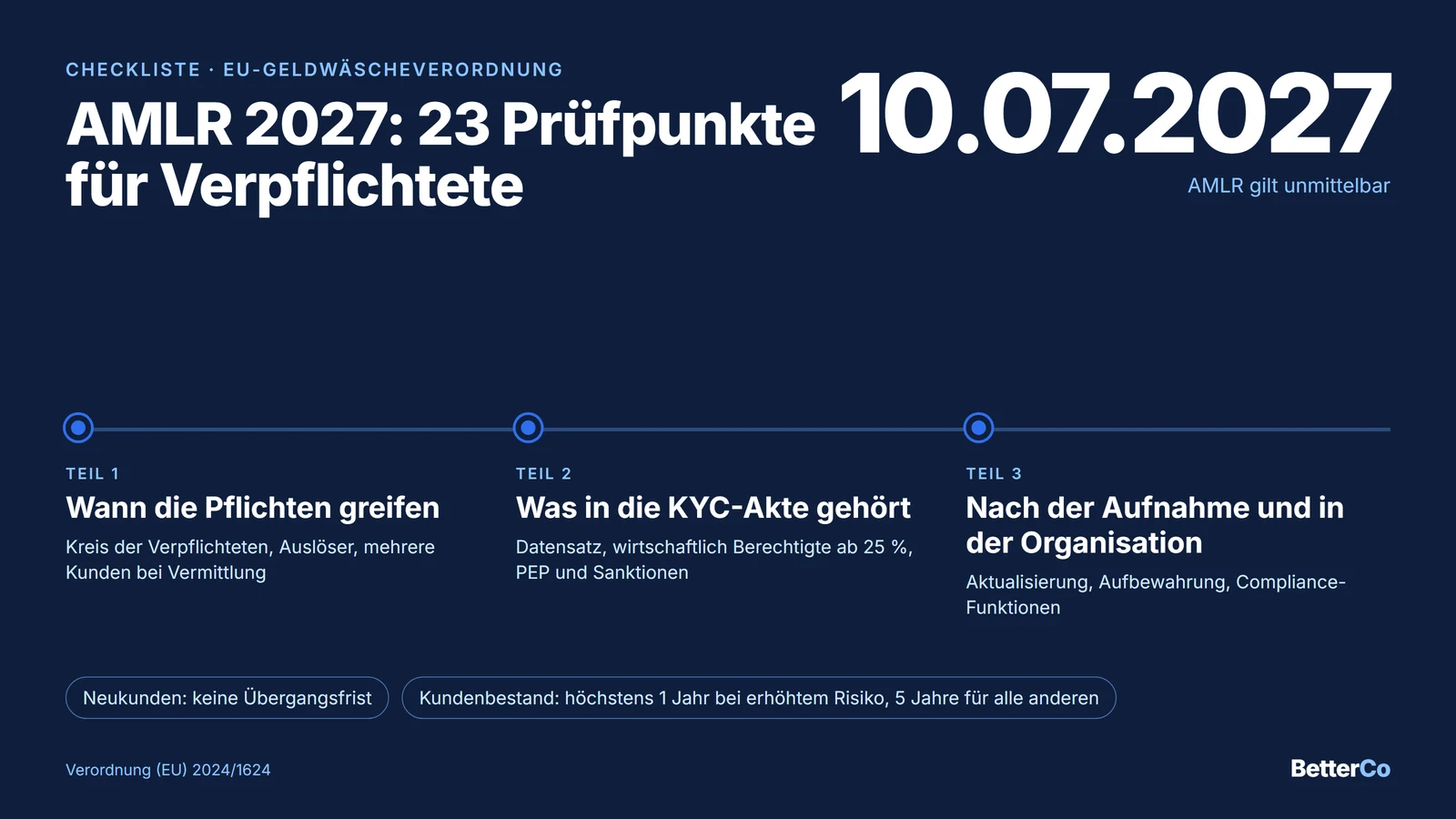 AMLR checklist 2027 for obliged entities
-
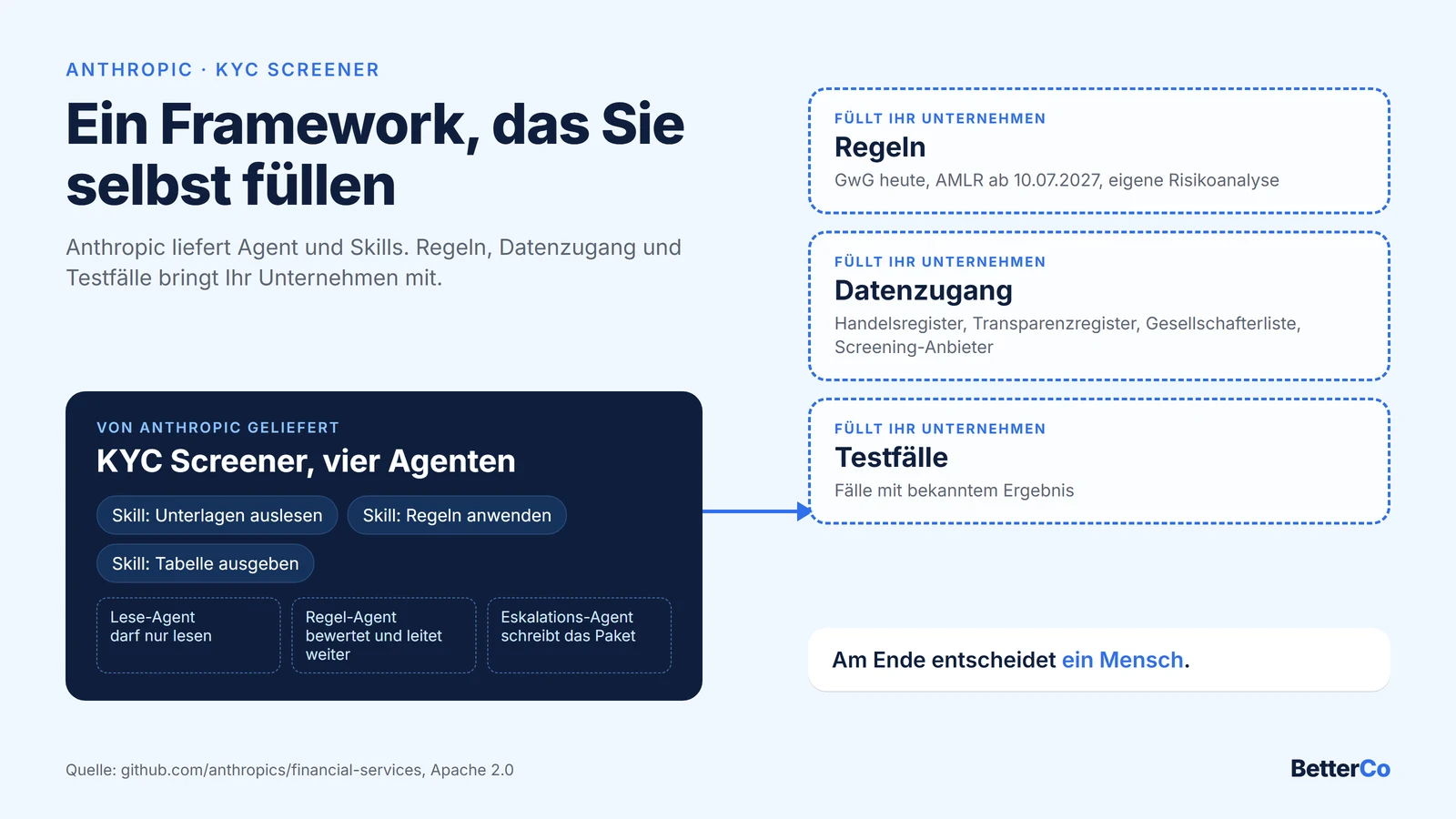 What Anthropic's KYC Screener does for German obliged entities
-
 Client onboarding on autopilot – here's how
-
 KYC and data protection: what you should know
-
 Artificial intelligence in the KYC process: the future of fighting money laundering
-
 Customer focus as a competitive advantage – 5 reasons why it pays off
-
 How do I choose the right KYC platform?
-
 Automate the KYC process in 4 simple steps
-
 What is KYC and why does it matter for my firm?
-
 Anti-money laundering – a health check for your business
-
 Faster client onboarding – made simple
-
 Why you need KYC software as an obliged entity
-
 BetterCo: interview with founder Eckhard Ortwein
-
 Paperwork is a challenge, even when it's digital