
AMLR checklist 2027 for obliged entities
October 15, 2026 · 9 minutes
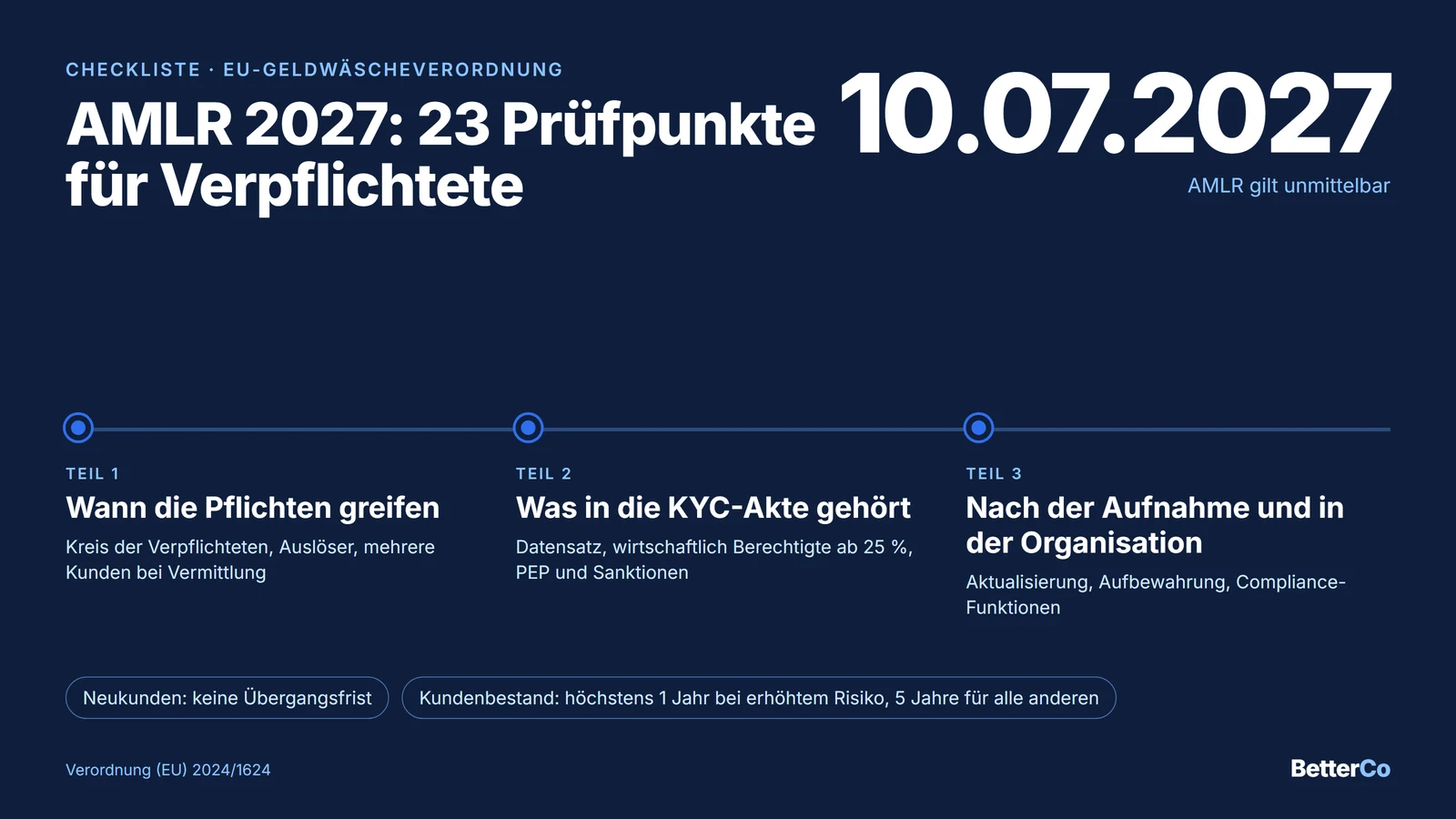
From July 10, 2027, the EU Anti-Money Laundering Regulation (AMLR, Regulation (EU) 2024/1624) applies directly to obliged entities, from banks and financial service providers to notaries, lawyers and tax advisors, real estate agents and goods traders. It governs the KYC check in more detail than the German Anti-Money Laundering Act (GwG). There is no transition period for new clients. For existing clients, every KYC file is subject to an update deadline of at most one year for high risk and at most five years for all other clients (Art. 26(2)). For each check item, the following checklist states what you should review by then, with the article of the regulation (legal status: October 2026).
Key points
- The AMLR applies directly from July 10, 2027, and to football agents and professional football clubs from July 10, 2029.
- New clients are checked under the new rules from day one.
- For existing clients, the update depends on the risk, at most one year for high risk and five years for all other clients.
- Beneficial owners are calculated across all levels, at a holding of 25% or more.
The checklist follows the course of a KYC check in three parts. The first part shows when the obligations apply. The second covers what belongs in a client's KYC file, and the third what applies after onboarding and within your organization. Obliged entities already know the check steps themselves from the GwG. They become more extensive and must be demonstrated to the supervisory authority.
What changes most compared with the GwG
| Check item | GwG today | AMLR from July 10, 2027 |
|---|---|---|
| Threshold for beneficial owners | more than 25 percent (Section 3(2) GwG) | 25% or more, multiplied across all levels (Art. 52(1)) |
| Beneficial owners | Collect the name, further attributes as appropriate to the risk (Section 11(5) GwG) | Verify the identity of every beneficial owner (Art. 22(7)) |
| Fictitious beneficial owners | legal representative, managing shareholder or partner (Section 3(2) sentence 5 GwG) | all members of senior management (Art. 63(4)(b)) |
| Update | no fixed maximum period | at most one year for high risk, five years for all other clients (Art. 26(2)) |
When the obligations apply
Check whether you are an obliged entity. In the future, the regulation itself defines the group of obliged entities (Art. 3). As today, it covers credit and financial institutions, real estate agents and goods traders, and now expressly also the brokering of leases with a monthly rent of €10,000 or more (Art. 3(3)(d)). New additions include crowdfunding service providers and credit intermediaries. For football agents and professional football clubs, the regulation applies only from July 10, 2029 (Art. 90). The AMLR-Check shows whether and to what extent you are affected.
For the legal professions, check each individual transaction. Notaries and legal advisors are obliged only for certain transactions, such as the purchase of real estate or companies and the formation of companies. The catalog now expressly names crypto-assets (Art. 3(3)(b)).
Tax advisors are obliged across the board. The regulation expressly names tax advisors, as well as any other person whose principal activity is assistance in tax matters (Art. 3(3)(a)).
Know the triggers. A check starts with the business relationship, for occasional transactions from €10,000, for the formation of companies regardless of value, on suspicion and when there are doubts about earlier information (Art. 19(1)). For an occasional cash payment of €3,000 or more, you must at least identify the client (Art. 19(4)).
Several clients in brokered transactions. If a legal professional is the only one brokering a transaction, both parties count as clients (Art. 19(6)(b)). The same applies to real estate agents (point (c)), and in trading high-value goods the supplier is added (point (a)).
What belongs in a client's KYC file
Complete data set for natural persons. The KYC file contains all first names and surnames, place and date of birth, all nationalities, the place of residence and, if available, the identity document number and tax number (Art. 22(1)). For each mandatory field, the draft technical standards specify a particular eID attribute (AMLA, consultation draft of February 9, 2026, Annex I; adoption pending).
Verify identity before you start. As a rule, verification takes place before the business relationship is established (Art. 23(1)). The regulation offers two options. One is presenting an identity document, the other an electronic identification means at assurance level “substantial” or “high” with the relevant qualified trust services under eIDAS (Art. 22(6)).
Check representation. The person acting on behalf of the client is identified and checked for their power of representation (Art. 20(1)(i)). Section 10(1) no. 1 GwG already requires this today.
Calculate beneficial owners across all levels. The threshold drops from “more than 25 percent” (Section 3(2) GwG) to “25% or more” (Art. 52(1)). Along a chain, the holdings are multiplied, and parallel strands are added; ownership and control are checked side by side (Art. 51–54).
An example shows the difference. In the fictitious Muster GmbH, Ms. A holds 40 percent and a Holding GmbH holds 60 percent, and Mr. B holds half of the Holding. Under the GwG, Mr. B counts only if he controls the Holding (Section 3(2) GwG), and with 50 percent and no further rights, he usually does not. Under the AMLR, he reaches 60 times 50 percent, or 30 percent, and is a beneficial owner.
Verify all beneficial owners. In the future, the identity of every beneficial owner must be verified with reasonable measures (Art. 20(1)(b), Art. 22(7)).
Determine fictitious beneficial owners. If no one can be identified, all members of senior management take the place of the beneficial owner (Art. 63(4)(b)).
Register extract and register query. For every new business relationship with a company, proof of registration or a current extract belongs in the KYC file (Art. 23(4)), as today under Section 12(3) GwG. In addition, obliged entities verify the information on beneficial owners by querying the Transparency Register (Art. 22(7), second subparagraph).
Report discrepancies within 14 days. If your own findings differ from the register, you must report this within 14 calendar days, with reasons (Art. 24(1)). An exception applies to findings from legal advice (Art. 24(4)).
Five details on the purpose. Instead of one line of free text, the regulation requires five details on every business relationship, including the source of funds (Art. 25).
Widen the PEP scope. Heads of regional and local authorities with 50,000 or more inhabitants also count as holding a prominent public function (Art. 2(34)). The client, the beneficial owners and the person on whose behalf someone acts must be checked (Art. 20(1)(g)). In the event of a match, senior management approval, establishing the source of funds and source of wealth, and enhanced monitoring are mandatory (Art. 42(1)).
Sanctions screening as a due diligence obligation. Screening against sanctions lists becomes part of the due diligence obligations (Art. 20(1)(d)) and is repeated on a risk basis (Art. 26(4)).
Assess reputation. The reputation of the client and the beneficial owners is a mandatory risk variable (Art. 20(2), Annex I). The obliged entity chooses the method, and data protection sets the limits (Art. 76).
Document the risk rating. The scope of the check is determined by the risk variables and risk factors in Annexes I to III, and you must be able to demonstrate its appropriateness to the supervisory authority at any time (Art. 20(2) and (4)). For complex or unusually large transactions, enhanced due diligence is mandatory (Art. 34(2)).
What applies after onboarding and within your organization
Set an update deadline for each KYC file. The regulation allows at most one year for high risk and at most five years for all other clients. Within these limits, the interval depends on the risk of the business relationship (Art. 26(2)).
Analyze your existing clients on a risk basis. There is no cut-off date for existing clients, because the update follows the deadlines in Art. 26(2). The risk determines how thoroughly each file is checked. The quality of the existing data decides whether a KYC file reaches the new standard with little or a lot of effort.
Retain due diligence records. You must retain copies of all documents from the due diligence check, including data from electronic identification (Art. 77(1)). If the due diligence obligation cannot be met, the business relationship is not entered into, an existing one is terminated, and a suspicious activity report must be considered (Art. 21(1)).
Be able to provide information covering five years. Obliged entities answer fully and promptly whether they had a business relationship with certain persons in the past five years (Art. 78).
Set up compliance functions, risk assessment and AI. A member of the management body is responsible as compliance manager, and a compliance officer runs day-to-day operations (Art. 11). The business-wide risk assessment is based on six prescribed inputs (Art. 10). Automated decisions and AI systems are permitted if decisions on onboarding, rejection and the depth of the check are subject to meaningful human intervention and the client can obtain an explanation (Art. 76(5)).
The AMLR-Check shows which items apply to your business. The legal position for each check step compared with the GwG is set out in the legal map of AMLR and eIDAS, and the white paper on the AMLR describes how onboarding changes from 2027.
Frequently asked questions
Do all existing clients have to be checked again by July 10, 2027?
No. The regulation sets no cut-off date for existing clients. Every KYC file is updated within the maximum periods in Art. 26(2), one year for high risk and five years for all other clients, and the risk determines how thoroughly it is checked.
Does a check under today's GwG replace the later update?
No. The update under Art. 26(2) measures the KYC file against the requirements of the regulation, such as the data set under Art. 22(1). A check under current law reduces the later update, but it does not replace it.
What changes most for beneficial owners?
Holdings are multiplied and added across every level, and the threshold is 25% or more (Art. 52(1)). In addition, the identity of every beneficial owner must be verified (Art. 22(7)).
When does the AMLR apply to professional football clubs?
For football agents and professional football clubs, the regulation applies from July 10, 2029 (Art. 90).
What BetterCo does for these check steps
BetterCo takes new clients through a questionnaire based on segment and legal form and retrieves data from the commercial register and the Transparency Register. AI reads the shareholder list, the register extract and the Transparency Register extract and records the page and wording for each piece of information; from this, BetterCo determines the beneficial owners across all levels. BetterCo screens clients and beneficial owners against PEP and sanctions lists and documents every check with an audit trail. For existing clients, BetterCo imports existing KYC files and assesses them in advance. Every KYC file gets a review path, and your team decides.

Related posts
-
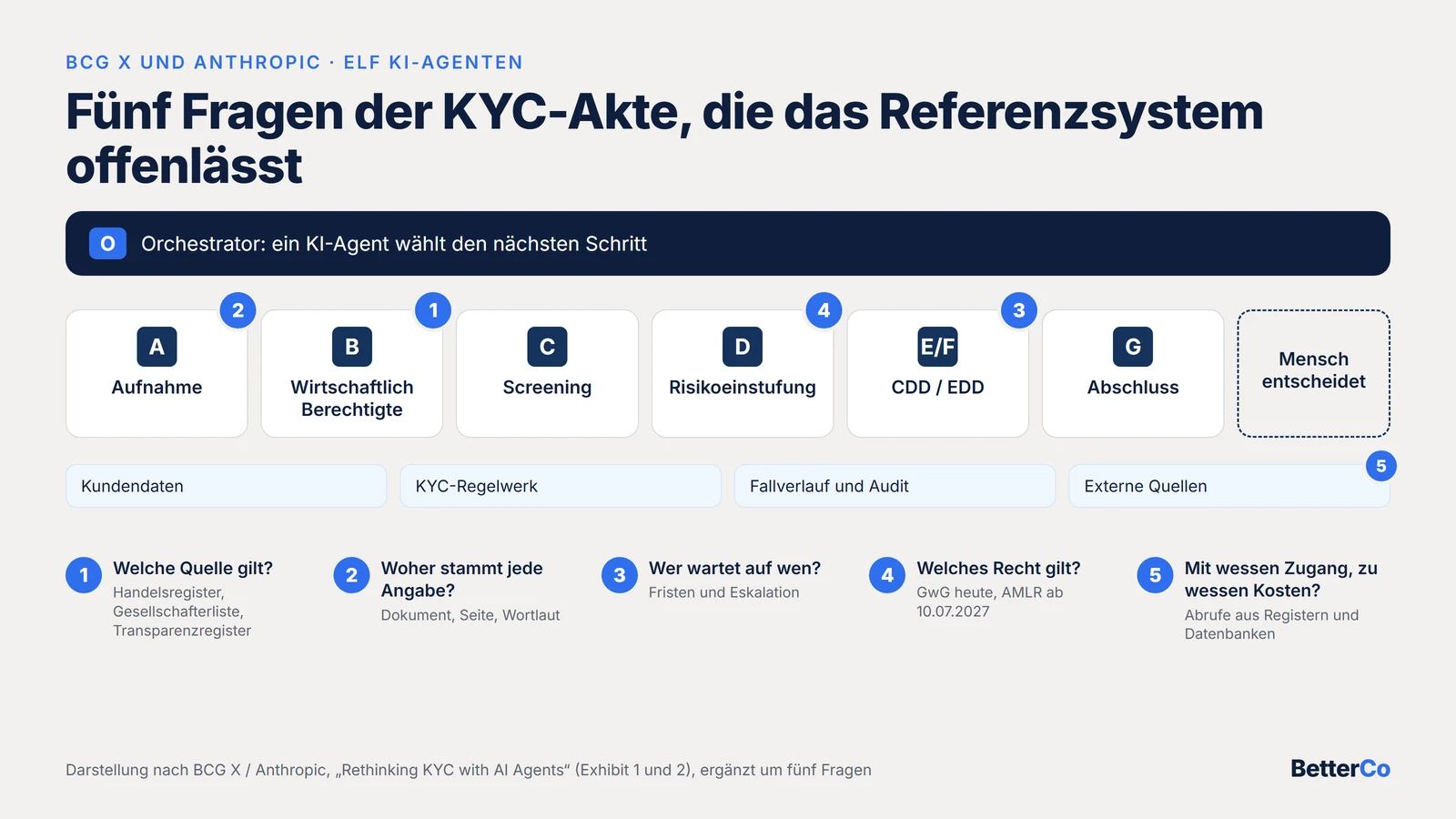 BCG and Anthropic leave five relevant questions open on KYC agents
-
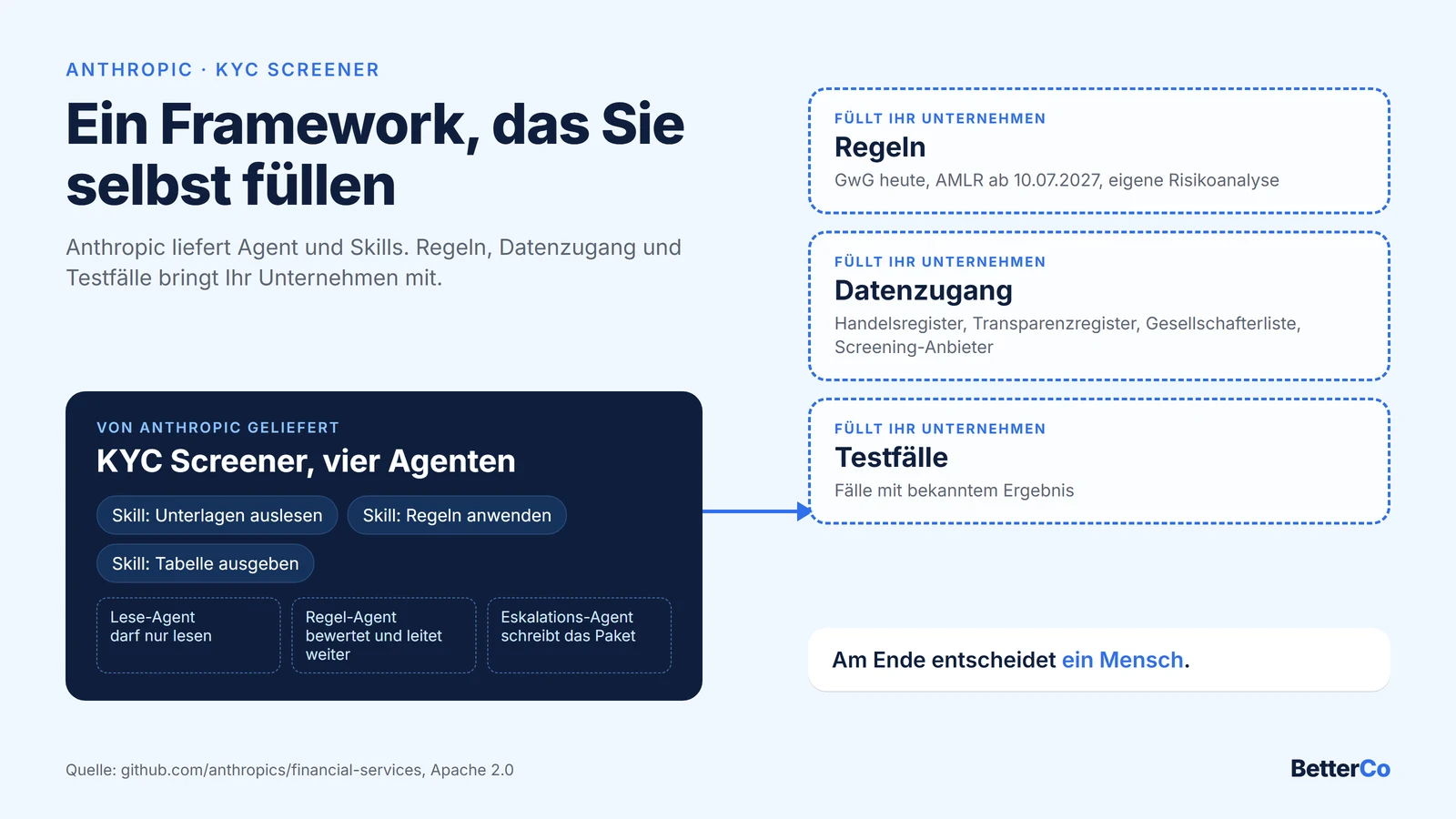 What Anthropic's KYC Screener does for German obliged entities
-
 Client onboarding on autopilot – here's how
-
 KYC and data protection: what you should know
-
 Artificial intelligence in the KYC process: the future of fighting money laundering
-
 Customer focus as a competitive advantage – 5 reasons why it pays off
-
 How do I choose the right KYC platform?
-
 Automate the KYC process in 4 simple steps
-
 What is KYC and why does it matter for my firm?
-
 Anti-money laundering – a health check for your business
-
 Faster client onboarding – made simple
-
 Why you need KYC software as an obliged entity
-
 BetterCo: interview with founder Eckhard Ortwein
-
 Paperwork is a challenge, even when it's digital