
What Anthropic's KYC Screener does for German obliged entities
September 17, 2026 · 9 minutes
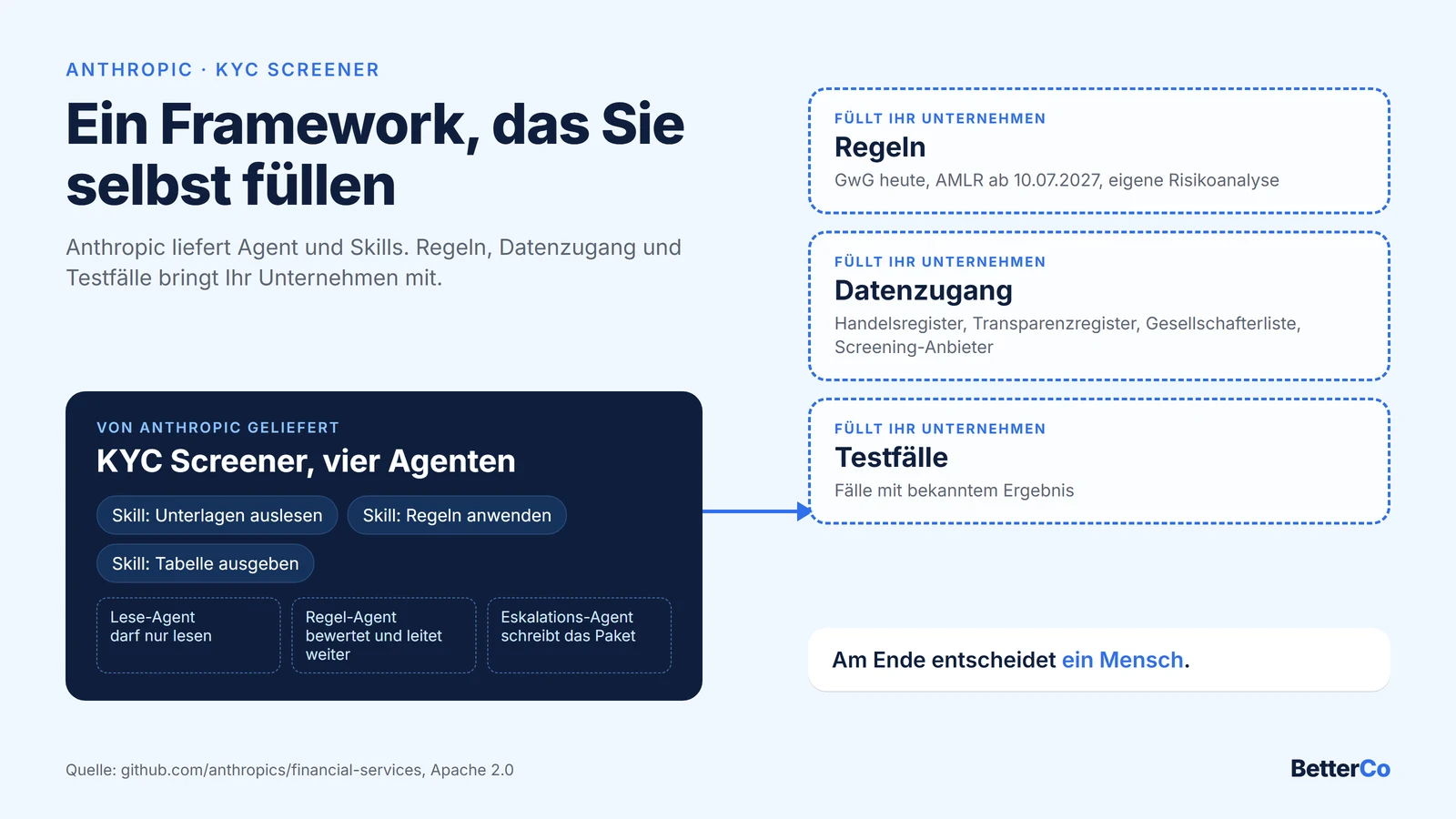
Anthropic makes the KYC Screener for Claude freely available on GitHub under the Apache 2.0 license. It is part of “Claude for Financial Services” (github.com/anthropics/financial-services), a collection of agents and skills for banks and other financial companies. The KYC Screener checks new clients. It reads their documents and applies the company's rules. It then screens individuals against sanctions and PEP lists and adverse media through a connected provider. At the end, it presents a recommendation on which the person responsible for compliance decides. Each company supplies the rules itself. For German obliged entities, the KYC Screener knows neither the rules of the GwG nor the Transparency Register and the shareholder list, because it is a general framework.
Key points
- The KYC Screener is a freely available framework from Anthropic with four agents and three skills.
- It prepares a decision, and a human makes it.
- Each company brings its own rules, data access and test cases.
- For a German KYC file, the rules of the GwG and the German register sources are missing.
Five terms up front
- KYC Screener. A “screener” is someone who reviews and sorts things out, closest to a pre-checker in German. In KYC, “screening” usually means matching against sanctions and PEP lists. The KYC Screener does more. It compiles a preliminary review on which a human decides.
- Framework. A framework is a blueprint with ready-made building blocks that a company fills with its own content. The KYC Screener defines the process, and the company defines the check rules.
- Agent. An agent is an AI model with a task and fixed permissions that carries out several steps in sequence. The KYC Screener consists of four agents. A controlling agent assigns the work to an agent that reads the documents, one that applies the rules, and one that builds the package for approval.
- Skill. A skill is a written work instruction for a task that an agent loads when needed. The KYC Screener has three skills, for extracting data from the documents, for applying the rules and for output as a table. A skill describes how the work is done; it contains no data and no check rules.
- Rules. Rules are the company's check requirements, called a “rules grid” in the KYC Screener. It defines which factors determine the risk, which documents must be on file for each client type and when a case escalates. The rules come from the company; Anthropic supplies only example factors.
For this article, we break the framework down into five layers, namely data access, rules, skills, orchestration and evaluation. Anthropic ships two of them, the skills and the agents that control them. Data access and rules are interfaces that the company fills, and the plugin contains no test cases.
The KYC Screener prepares a decision
The controlling agent works in four steps. In the first, the reading agent extracts structured information from the PDF documents of an onboarding package, such as name, legal form, beneficial owners, representatives, source of funds and a list of the documents submitted. In the second, the rules agent checks every company rule against this information. In the third, every named person is screened against sanctions and PEP lists and adverse media. In the fourth, the escalation agent compiles a package with the gaps, the matches and a recommended risk level.
Three requirements concern security. The client's documents are treated as untrusted; the reading agent may only read and returns a result with a fixed structure and length. Only the escalation agent may write. And the KYC Screener does not assign a binding risk rating. The skill for the rules (kyc-rules) “decides nothing, it scores and routes”. Every rule result appears in the output with the rule number and the field that triggered it.
Five layers separate the reusable part from your own content
The layers show which work the framework takes off your hands and which remains with the obliged entity.
| Layer | In the KYC Screener | What a German obliged entity adds |
|---|---|---|
| Data access | an interface for screening (sanctions, PEP, adverse media), without a provider | commercial register, Transparency Register, shareholder list, a screening provider |
| Rules | a “rules grid” provided by the company; example factors | the rules under the GwG and, from July 10, 2027, under the AMLR, your own risk assessment |
| Skills | Read documents, apply rules, output the result as a table | German document types and legal forms |
| Orchestration | a controlling agent with three further agents and fixed permissions | deadlines, reminders, representation, approval within your own team |
| Evaluation | no test cases in the plugin | cases with a known outcome against which the system can be measured |
For data access and rules, the framework specifies the format; for evaluation, not even that. Each company develops the content of these three layers itself, and this content decides whether a KYC file stands up to an audit.
The content follows Anglo-American onboarding
The examples in the KYC Screener come from US and UK onboarding. As tax documents, it names the US forms W-9 and W-8BEN-E and the CRS self-certification, and as proof of address a utility bill no more than three months old. Beneficial owners appear as a list with name, nationality and percentage holding. A chain of holdings feeds into the risk as the factor “Ownership opacity”, and more levels mean higher risk.
For the KYC file of a German GmbH, this leaves out the sources and their ranking. The shareholder list filed in the commercial register shows the holdings. Information from the Transparency Register alone is not sufficient (Section 11(5) sentence 3 GwG), and discrepancies with the Transparency Register must be reported (Section 23a(1) GwG). If no natural person can be identified as the beneficial owner, the legal representative, the managing shareholder or the partner is deemed the beneficial owner (Section 3(2) sentence 5 GwG). None of these rules is in the KYC Screener, and none can be derived from its example factors.
An example shows the difference. In the fictitious Muster GmbH, Ms. A holds 40 percent and a Holding GmbH holds 60 percent. Mr. B holds half of the Holding, and several family members share the other half in small stakes. Only Ms. A is entered in the Transparency Register, and under current law that is correct. Under the GwG, Mr. B counts only if he controls the Holding, and with half of the shares and no further rights, he usually does not (Section 3(2) GwG). The KYC Screener detects a chain of holdings and raises the risk. For the German KYC file, that is where the work begins. The shareholder list shows the Holding, so you need to establish who is behind it. From July 10, 2027, holdings are multiplied along the chain, and Mr. B reaches 60 times 50 percent, or 30 percent (Art. 52(1) AMLR). He is then a beneficial owner, and if the Transparency Register differs from this, it must be reported (Art. 24(1) AMLR).
Fixed rules should control the process of a German KYC file
In the KYC Screener, an AI agent controls the process and assigns the subtasks. For a KYC file that a supervisory authority traces years later, there is more to be said for fixed rules. A rule states its name and version, and the same case reaches the same result when replayed. The language model then has a narrowly defined task. It reads documents such as the shareholder list and records the page and wording for each piece of information it extracts. The calculation of holdings and the ranking of sources remain verifiable logic. At the end, a human signs off the case.
The framework does not cover two points. Retrievals from the Transparency Register and from commercial databases cost money, and a system that queries sources itself needs spending limits per case. In addition, every retrieval should run with the obliged entity's access, so that it falls under its responsibility and sits in its KYC file.
An obliged entity can ask every AI provider three questions
For building your own KYC system, the KYC Screener is a good template. It separates read and write permissions and treats client documents as untrusted input. Every result names its rule, and the decision stays with a human. If you are choosing an AI-powered KYC tool, ask the provider three questions.
Which rules does the system check against, and in which version?
Which registers does it read from, and which source prevails in a conflict?
Who approves the case, and how is this approval documented in the KYC file?
Frequently asked questions
Is the KYC Screener free?
The code is freely available under the Apache 2.0 license. Running it incurs costs for Claude and for the connected data sources.
Can a German obliged entity use the KYC Screener directly?
Not without work of your own. The rules under the GwG and AMLR, access to the commercial register and the Transparency Register, and a screening provider come from the company. The system is measured against cases with a known outcome.
Does the KYC Screener decide on a client?
No. It recommends a risk level, and the person responsible for compliance decides.
What is the difference between an agent and a skill?
An agent works through a task in several steps and has fixed permissions. A skill is a work instruction that an agent loads for a specific task.
What BetterCo already implements today
In BetterCo, rules in the workflow determine which check step comes next and what information a case needs; your team decides. BetterCo retrieves data from the commercial register and the Transparency Register and screens clients and beneficial owners against sanctions and PEP lists. Every check is recorded in the KYC file with an audit trail. The language model reads the register documents and records the page and wording for each piece of information; from this, BetterCo determines the beneficial owners according to fixed rules for each legal form, and your team signs off the case. The features show the process in detail. The legal map of AMLR and eIDAS shows which obligations the AMLR brings from July 10, 2027, and the AMLR quick check asks six questions to find out what information it requires for your business.

Related posts
-
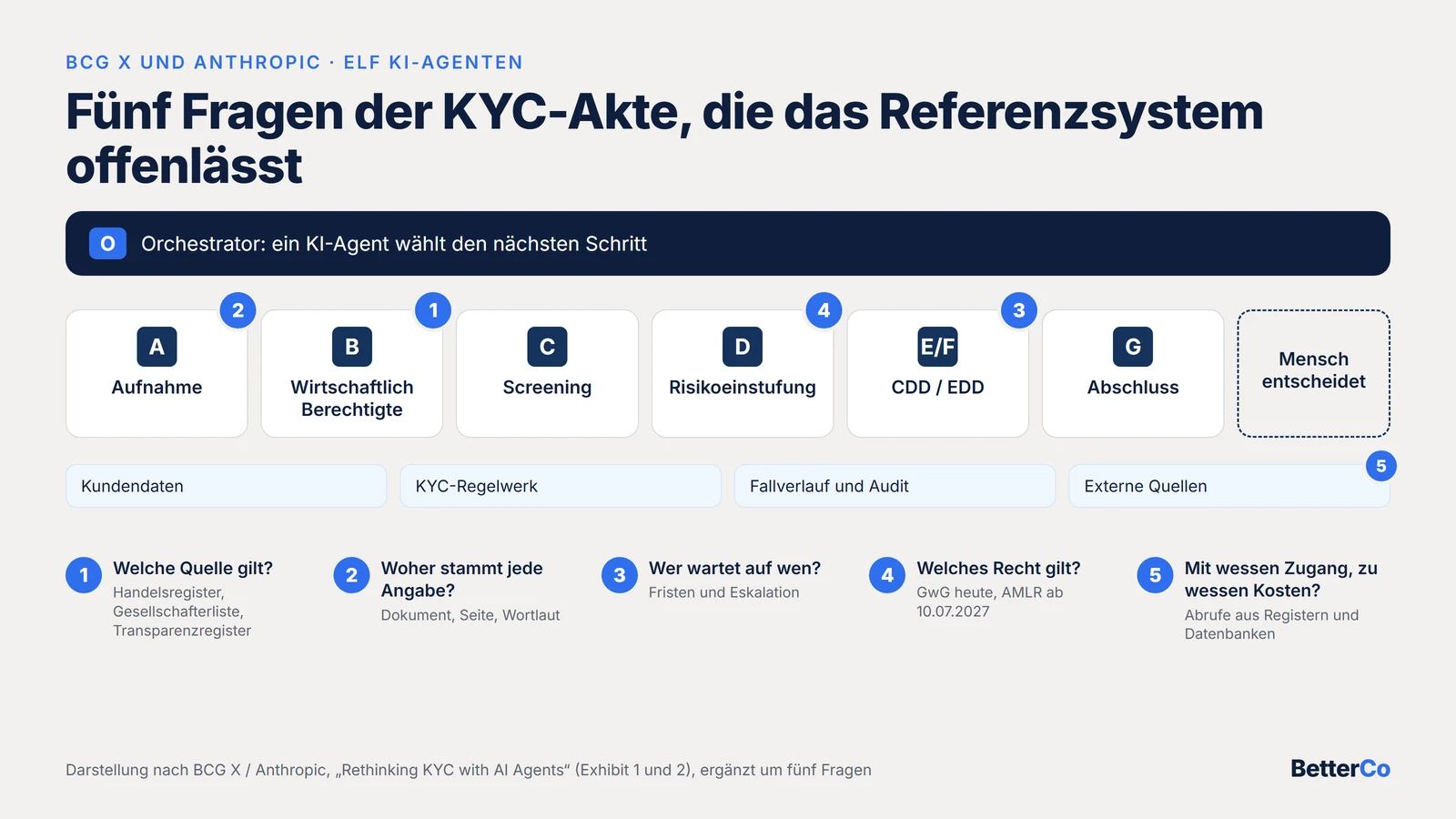 BCG and Anthropic leave five relevant questions open on KYC agents
-
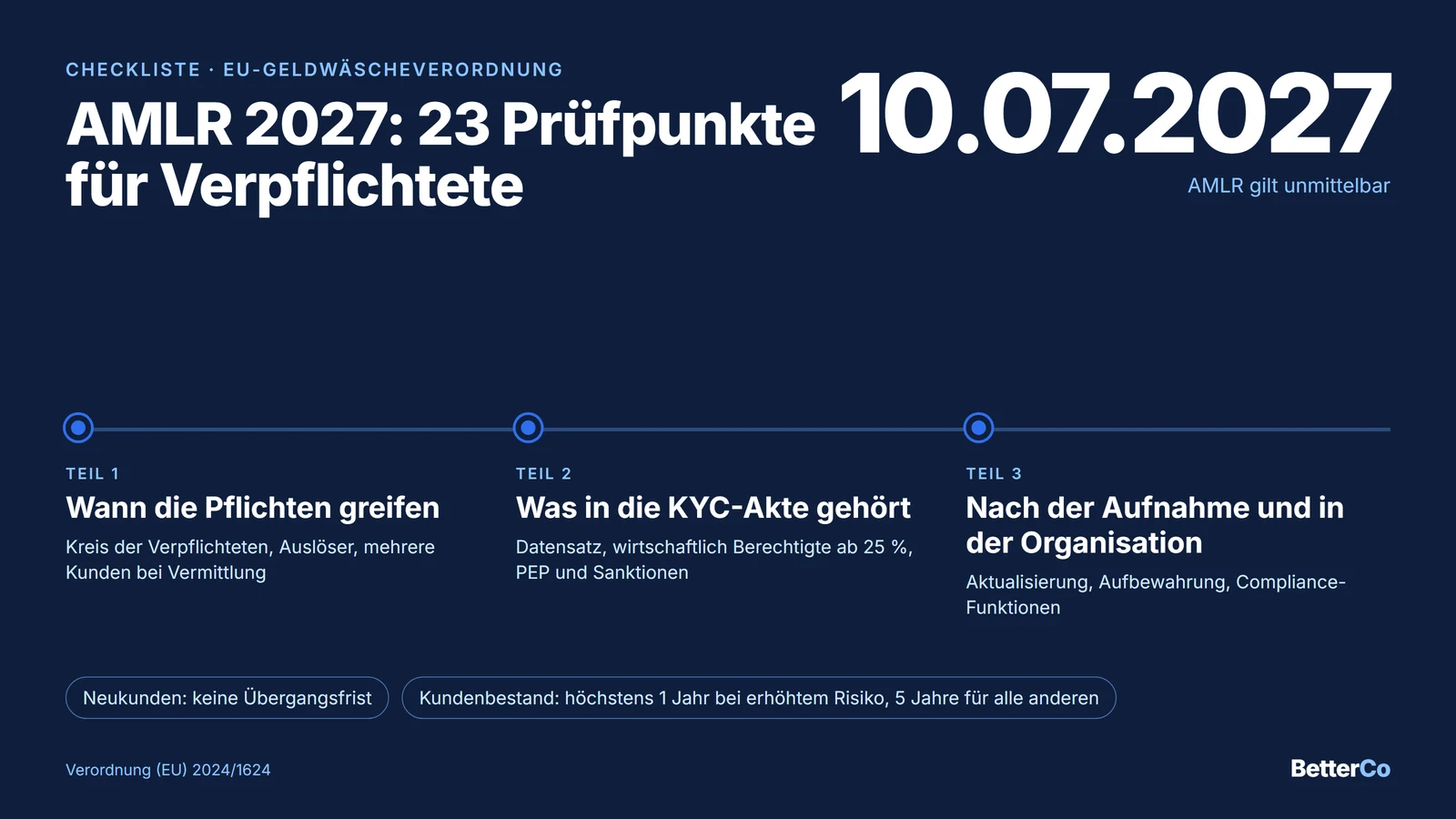 AMLR checklist 2027 for obliged entities
-
 Client onboarding on autopilot – here's how
-
 KYC and data protection: what you should know
-
 Artificial intelligence in the KYC process: the future of fighting money laundering
-
 Customer focus as a competitive advantage – 5 reasons why it pays off
-
 How do I choose the right KYC platform?
-
 Automate the KYC process in 4 simple steps
-
 What is KYC and why does it matter for my firm?
-
 Anti-money laundering – a health check for your business
-
 Faster client onboarding – made simple
-
 Why you need KYC software as an obliged entity
-
 BetterCo: interview with founder Eckhard Ortwein
-
 Paperwork is a challenge, even when it's digital