
What an AI agent checks in KYC review and what your team decides
November 26, 2026 · 8 minutes
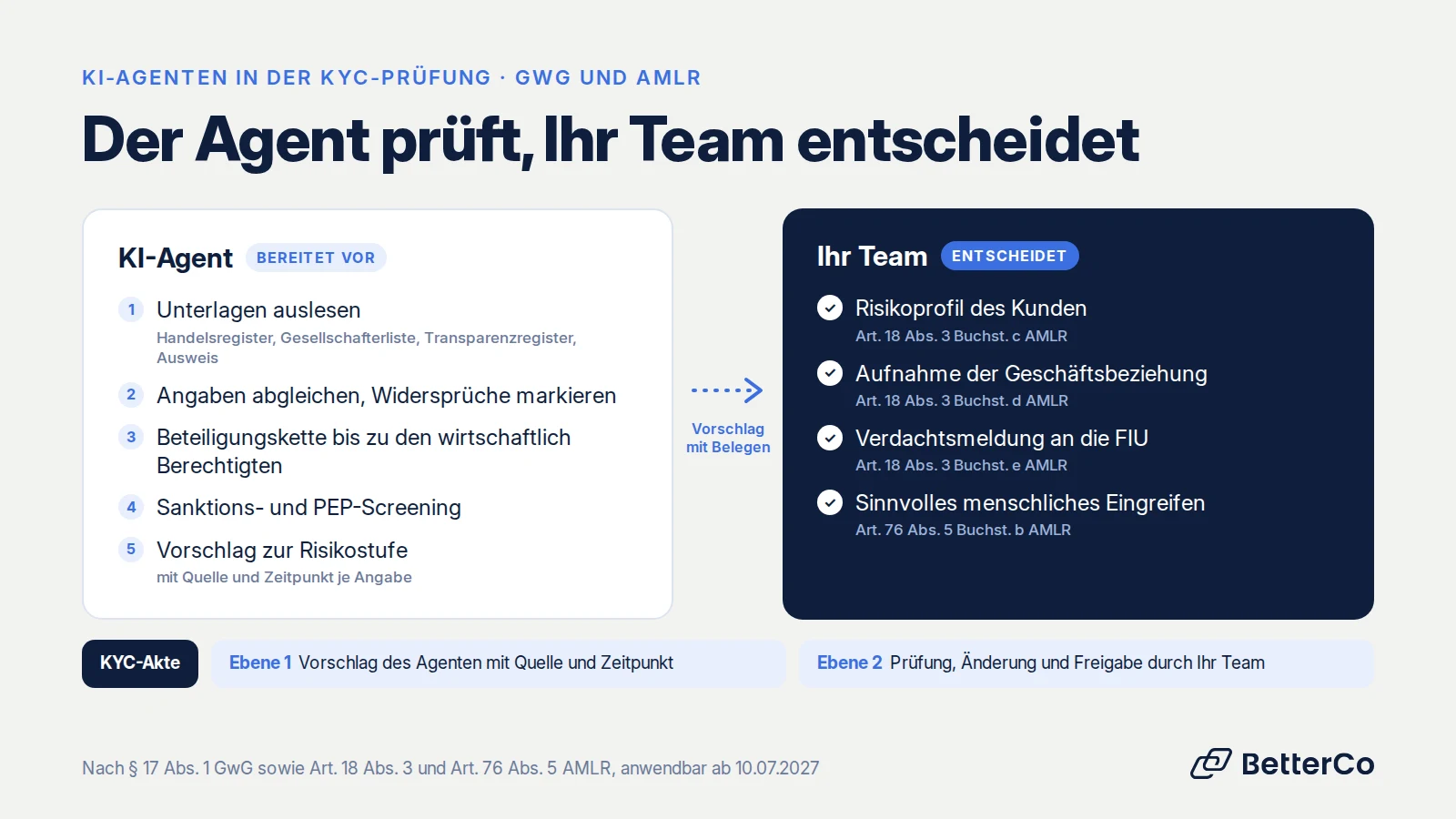
In KYC review, an AI agent can read documents, retrieve registers, cross-check information and propose a risk rating. A person at the obliged entity makes the decisions about the customer. From July 10, 2027, AI-based decisions to enter into, refuse or maintain a business relationship are subject to meaningful human intervention (Art. 76(5)(b) AMLR). The decision on the customer's risk profile cannot be outsourced (Art. 18(3)(c) AMLR), and under the GwG the obliged entity already remains responsible for due diligence today (Section 17(1) GwG).
Key points
- In KYC review, an AI agent takes on the work with documents and registers and presents the result with its evidence.
- From July 10, 2027, decisions on the business relationship that come from an AI system are subject to meaningful human intervention (Art. 76(5) AMLR).
- The risk profile, the decision to onboard the customer and the suspicious activity report stay with the obliged entity even when tasks are outsourced (Art. 18(3) AMLR).
- A person can only review a proposal if they see the sources, contradictions and open points and can change every item.
- The KYC file records separately what the agent proposed and what your team decided.
The division of labor follows from four questions. They concern the due diligence steps an agent can prepare, the decisions that stay with the obliged entity, the form in which a person can review a proposal, and the way the KYC file records each step.
The agent takes on the work with documents and registers
General due diligence obligations include identifying the contracting party, clarifying the beneficial owner, assessing the purpose and nature of the business relationship and determining whether a politically exposed person is involved (Section 10(1) GwG). If the contracting party is a company, the obliged entity must establish its ownership and control structure by appropriate means (Section 10(1) no. 2 GwG). From 2027, the AMLR also lists screening for targeted financial sanctions as a due diligence measure (Art. 20(1)(d) AMLR). Much of this work consists of reading documents and cross-checking information.
An agent can take on this work. It reads the commercial register extract, the shareholder list, the Transparency Register extract and the ID document, and checks whether the documents belong to the same company and whether the shares in the shareholder list add up to the share capital. It follows the ownership chain across several layers of companies down to the natural persons. It screens the customer and the persons involved against sanctions and PEP lists and compiles a proposed risk rating from all results.
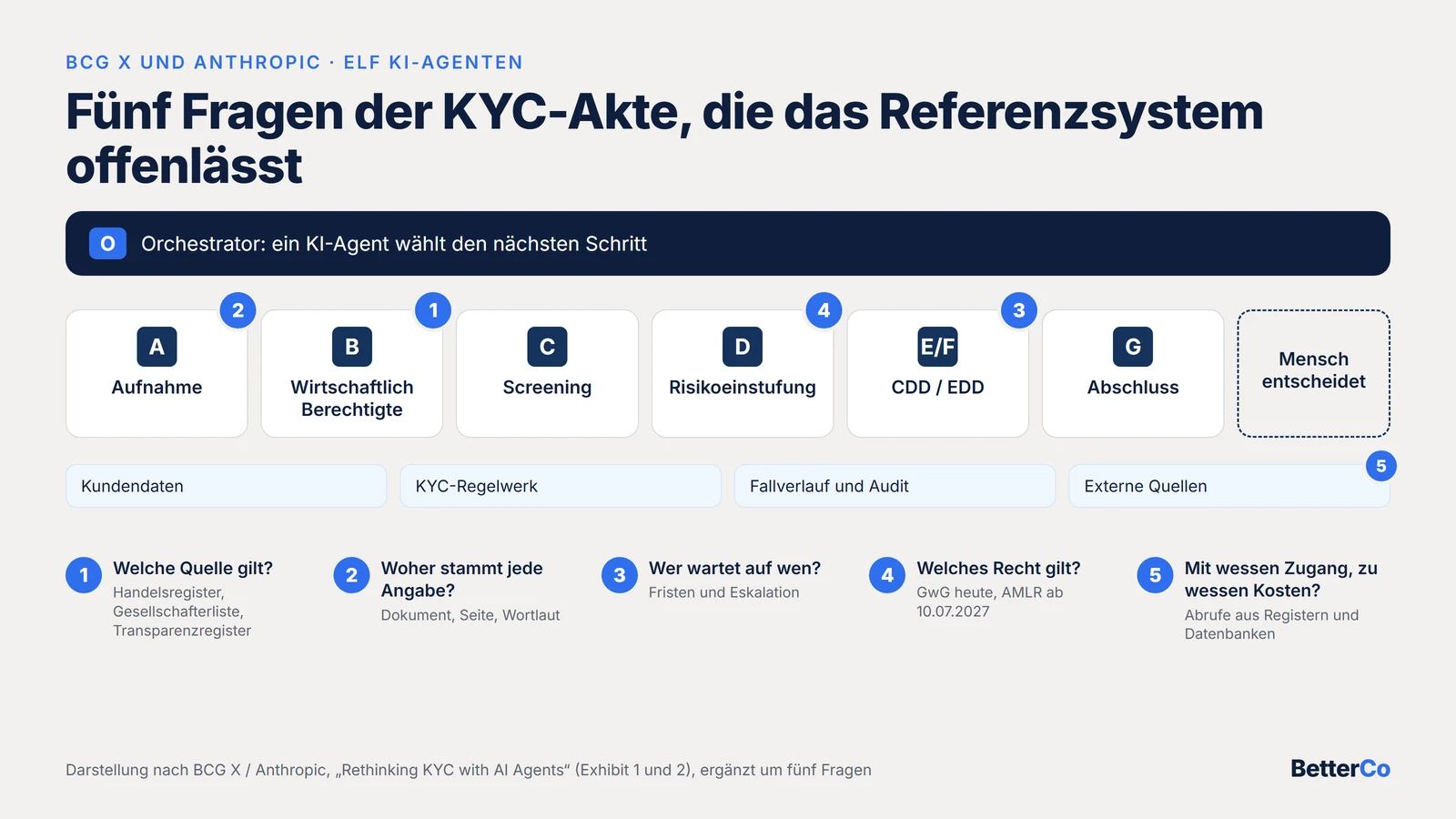
For the beneficial owner, a single source is not enough. The information must be collected from the contracting party, and collecting it from the Transparency Register alone does not fulfill the obligation (Section 11(5) sentence 3 GwG). An agent that puts the shareholder list, the customer's information and the Transparency Register side by side flags every discrepancy between them. Which source prevails in a conflict is covered in our article on the open questions about KYC agents.
Risk profile, onboarding and suspicious activity reports stay with the obliged entity
The AMLR lists tasks that an obliged entity may not outsource under any circumstances (Art. 18(3) AMLR). Three of them matter for the individual KYC review. The obliged entity itself decides on the customer's risk profile (point (c)), on entering into the business relationship or carrying out an occasional transaction (point (d)) and on reporting suspicious activity to the FIU (point (e)). In our view, what not even a service provider may take on, the obliged entity certainly does not leave to an AI system.
The same principle applies under the GwG today. If an obliged entity relies on third parties to meet its general due diligence obligations, the responsibility remains with it (Section 17(1) GwG). If it transfers measures to other companies by contract, those measures are attributed to it as its own (Section 17(5) GwG). For a politically exposed person or a higher risk, entering into or continuing the business relationship requires the approval of a member of senior management (Section 15(4) sentence 1 no. 1 GwG).
If an obliged entity cannot meet its general due diligence obligations, it may not enter into or continue the business relationship (Section 10(9) GwG). An exception applies to legal advice and litigation (Section 10(9) sentence 3 GwG). An agent shows which document is missing and follows up with the customer. Your team judges whether the gap can be closed or the case ends.
Meaningful human intervention requires a proposal that can be reviewed
The AMLR allows decisions resulting from automated processes and from processes involving AI systems under three conditions (Art. 76(5) AMLR). The system processes only data obtained under the customer due diligence rules (point (a)). Decisions to enter into, refuse or maintain a business relationship and to increase or reduce the due diligence measures are subject to meaningful human intervention that ensures their accuracy and appropriateness (point (b)). The customer can obtain an explanation of the decision and challenge it, except in connection with a suspicious activity report (point (c)).
Art. 76 AMLR does not describe in more detail what the intervention must look like. In our view, a person intervenes meaningfully when they can verify and change the proposal. For this, they see the source of every item and the time it was collected. Contradictions between sources and open points come before the unremarkable items, and every item and the proposed risk level can be changed.
The explanation to the customer requires the same. For the customer to obtain an explanation, the company needs the reasons for a decision in a form it can pass on. A proposal that only outputs a score does not provide these reasons. A proposal that states each risk question with its answer and the answer's source does.
In many tax firms and real estate agencies, a single person reviews every case. That person saves time when the agent shows the discrepancies first and the remaining items with their evidence after them.
The KYC file shows who is responsible for each step
The obliged entity records the information collected, along with sufficient information on how the risk assessment was carried out, its results and the appropriateness of the measures taken (Section 8(1) nos. 1 and 2 GwG). At the supervisor's request, it demonstrates that the scope of its measures is appropriate to the risk (Section 10(2) sentence 4 GwG). From 2027, anyone who outsources tasks to a service provider must also demonstrate to the supervisor that they understand the service provider's approach (Art. 18(2) AMLR).
In our view, the KYC file of an AI-powered review therefore records two levels separately. The first level shows what the agent read, cross-checked and proposed, each with source and time. The second shows which person reviewed, changed or approved the proposal, and with what reasoning. If your team departs from the proposal, the reasoning sits next to the original proposal.
This separation also helps with the later update. Documents, data and information must be updated at appropriate intervals, taking the risk into account (Section 10(1) no. 5 GwG). If the source and collection date of every item are known, the agent identifies the outdated items during ReKYC, and your team decides again on the updated KYC file.
Frequently asked questions
May an AI agent decide on its own whether a customer is onboarded?
No. From July 10, 2027, this decision is subject to meaningful human intervention (Art. 76(5)(b) AMLR) and cannot be outsourced (Art. 18(3)(d) AMLR). Under the GwG, the responsibility already remains with the obliged entity today (Section 17(1) GwG).
When do the AMLR rules apply?
The AMLR applies from July 10, 2027, and to football agents and professional football clubs from July 10, 2029 (Art. 90 AMLR). Until then, the GwG and its rules on the obliged entity's responsibility apply.
Is it enough for the agent to query the Transparency Register?
No. Collecting the information from the Transparency Register alone does not fulfill the obligation to collect the beneficial owner's information (Section 11(5) sentence 3 GwG). The agent therefore cross-checks the register against the shareholder list and the customer's information.
Can the customer challenge an AI-powered decision?
Yes. The customer can obtain an explanation of the decision and challenge it, except in connection with a suspicious activity report (Art. 76(5)(c) AMLR). The section on human intervention describes what this means for the agent's proposal.
What BetterCo takes on in KYC review
In BetterCo, the KYC Agent reads the commercial register extract, the shareholder list, the Transparency Register extract and the ID document, checks them against each other and resolves the ownership chain down to the beneficial owners. For every field, BetterCo records where the value comes from and when it was collected, and contradictions between documents are flagged. The same analysis produces a review report for the Anti-Money Laundering Officer (AMLO) and a task list for the case handlers. BetterCo screens the customer and every person involved against sanctions, PEP and adverse lists, pre-fills the risk questions and proposes one of four risk levels. Your team reviews, adjusts and gives reasons for any changes, and the KYC file shows who approved what and when. We will show you what the review report and approval look like in your process in a demo.

Related posts
-
 BCG and Anthropic leave five relevant questions open on KYC agents
-
 AMLR checklist 2027 for obliged entities
-
 What Anthropic's KYC Screener does for German obliged entities
-
 Client onboarding on autopilot – here's how
-
 KYC and data protection: what you should know
-
 Artificial intelligence in the KYC process: the future of fighting money laundering
-
 Customer focus as a competitive advantage – 5 reasons why it pays off
-
 How do I choose the right KYC platform?
-
 Automate the KYC process in 4 simple steps
-
 What is KYC and why does it matter for my firm?
-
 Anti-money laundering – a health check for your business
-
 Faster client onboarding – made simple
-
 Why you need KYC software as an obliged entity
-
 BetterCo: interview with founder Eckhard Ortwein
-
 Paperwork is a challenge, even when it's digital